Written by: Kheng Hong
31st July 2026
My Experience at SB64
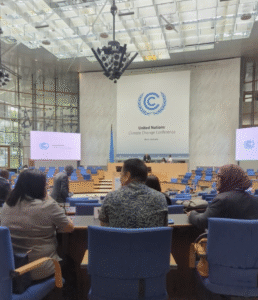
This was my first time joining a Subsidiary Body (SB) meeting physically at Bonn, Germany and it was an exciting and eye-opening experience for me. Prior to SB64, I was only able to track Article 6.2 mandated events virtually (and admire the magnificence of Chamber Hall) through the UNFCCC broadcasting platform.
This time around, I managed to closely track Article 6 negotiations on the ground, mainly focusing on two tracks – Article 6.2 Cooperative Approaches and Article 6.8 Non-Market Approaches. There were also UNFCCC events such as Article 6 Market Day and Article 6.2 Ambition Dialogue. It was definitely a lot to take in, but it was a lot of fun!
Context on Article 6
A brief introduction to Article 6: there are three main components under Article 6 of the Paris Agreement – Article 6.2, Article 6.4 and Article 6.8 – all three of which have different roles to play. Article 6 aims to encourage voluntary cooperation between countries to enable higher ambition in their mitigation and adaptation actions.
Article 6.2 is about cooperative approaches, where countries can engage in bilateral agreements to trade emission reductions (also known as international transferred mitigation outcomes – ITMOs); Article 6.4 is United Nation’s centralized carbon crediting mechanism (also known as Paris Agreement Crediting Mechanism – PACM). Meanwhile, Article 6.8 sets out the framework for Non-Market Approaches (NMA). The exact paragraphs in the Paris Agreement text are as below.


Relevancy to Malaysia
Malaysia’s carbon market continues to mature, especially with the recent launch of the National Carbon Market Policy (DPKK). The developments under Article 6 of the Paris Agreement are crucial as the negotiation outcomes at SB and COP will determine the rules and resources available for international cooperation. As a developing country, Malaysia requires clarity and international support to ensure meaningful participation in Article 6.
The outcomes of the Article 6.8 work programme review at SB64 and further at COP31 will be particularly significant in shaping Malaysia’s engagement in non-market approaches, including through the NMA platform. During COP30, Malaysia Forest Fund (MFF) had presented the possibility of Forest Conservation Certificate (FCC) as Intended NMA. The review will have implications for the recognition and operationalisation of non-market approaches, including the possibility of listing future approaches under the NMA platform and creating pathways to further scale their implementation.
At the same time, further discussions on funding arrangements under Article 6.2 remain critical with Malaysia’s recent progress on bilateral cooperation with different countries (see related news coverage for Korea, Singapore and Japan). The availability of enabling support and infrastructure can ensure the clarity on participation in cooperative approaches, as well as safeguard the environmental integrity associated with carbon credit transactions.
Article 6.8
Article 6.8 of the Paris Agreement considers how Parties can support climate action without involving the transaction of carbon or quid pro quo operation. It operates through results-based approaches and is distinct from the carbon market mechanism (no carbon credit involved!).
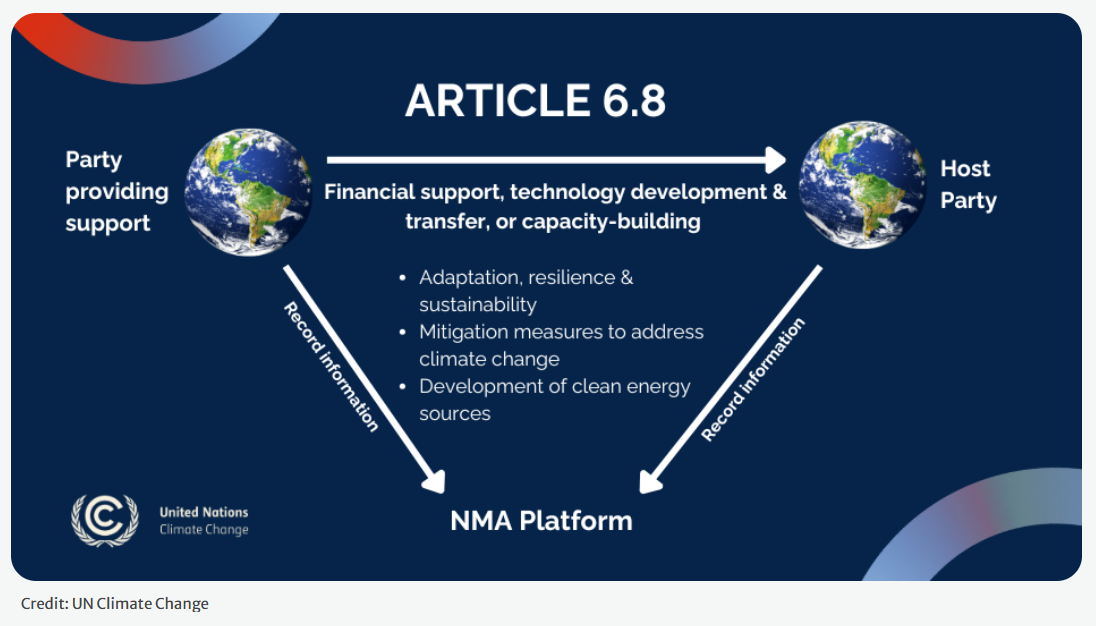
For example, Uganda has listed Adaptation Benefit Mechanism (ABM) as a NMA in cooperation with other African countries. The ABM is a results-based financial mechanism designed to mobilize public and private finance for adaptation.
The secretariat presented an update on Article 6.8 during SB64:
- 2 new NMAs were recorded on the NMA Platform, bringing the total to 5 records (now 6 already!)
- 120 A6.8 national focal points had been designated (now 121 already!)
- The focal point serves as a contact point between the Party and the UNFCCC, facilitating the communication of official information regarding the progress of implementing decisions related to NMAs.
- Fun fact: Malaysia’s A6.8 national focal point is Malaysia Forest Fund.
During SB64 across a few days, there were two agenda items are discussed related to Article 6.8:
- SBSTA Agenda item 10 (a): Meeting of the Glasgow Committee on Non-market Approaches (GCNMA)
- SBSTA Agenda item 10 (b): Review of the work programme under the framework of non-market approaches
Ninth (9th) Meeting of GCNMA
GCNMA stands for Glasgow Committee on Non-market Approaches, that governs the framework of Non-Market Approaches and implements the work programmes through modalities i.e. in-session workshop and spin-off groups.
For the 9th meeting of the GCMA, an in-session workshop (9 June) under the framework for non-market approaches was conducted. The workshop began with presentations from participants, followed by a World Café session. One of the highlights was the safeguard concepts for Article 6.8, presented by the EU coordinator:
- Voluntary and proportionate
- Identifying and managing environmental and social risks
- Aligned with principles in the Paris Agreement preamble
- Respect for diverse national circumstances and types of NMA
Another modality for Article 6.8 work programme is Spin-off groups (10 June). It is to facilitate in-depth discussion by interested parties on specific topics related to NMAs. Following the workshop and spin-off group discussion, Parties reconvened to share their key takeaways and reflections from the sessions. Some of the topics of the spin-off groups included transitions away from fossil subsidies, unilateral trade measures, and the protection of marine biodiversity. The Philippines as the 2026 ASEAN chair also convened a small spin-off group on the implementation of Article 6.8 for the ASEAN!
Based on the sessions conducted above, the Chair circulated a draft conclusion text for Parties’ consideration. The Parties reconvened to provide interventions and propose necessary amendments on the draft conclusion text. Following that, the Chair adopted the draft conclusions text, bringing this agenda item to a close.
Review of the Work Programme under the Framework of Non-Market Approaches
At COP26 in Glasgow, the Parties adopted the work programme under the Article 6.8 framework (Decision 4/CMA.3).
- Article 6.8 work programme is to facilitate the use and coordination of NMAs, as well as enhance linkages and synergies among countries.
- Since then, the work programme has set out multiple capacity-building activities and operationalized the NMA Platform, including features like online discussion forum and knowledge resources.
Later at COP27 in Sharm el-Sheikh, the Parties decided the implementation details for the mitigation work programme (Decision 4/CMA.4).
- Mitigation work programme (MWP) is to scale up mitigation ambition and implementation, complementing the global stocktake. It was established during COP26 (Decision 1/CMA.3).
- The MWP includes at least two global dialogues each year:
- Focused exchange of views, information and ideas;
- Investment-focused events, considering the cost of mitigation implementation, with a view to unlocking finance
Fast forward to COP29 in Baku and COP30 in Belém, the Parties discussed creating a digital platform to facilitate collaboration among stakeholders in implementing the MWP (Decision 2/CMA.6). The Parties also recognized the existing infrastructure of NMA Platform and subsequently requested the secretariat to consider options for further integration as part of the review of the Article 6.8 work programme (Decision 13/CMA 7).
Therefore, the secretariat presented a technical paper exploring options to:
- Enable the recording of projects identified under the Sharm el-Sheikh Mitigation Work Programme (MWP) on the NMA Platform
- Option 1 – No changes to the NMA Platform
- Option 2 – Changes to the NMA Platform
- Enable the interconnection between the NMA platform and other relevant platforms, including national platforms
- Option 1 – Addition of hyperlinks to the NMA Platform,
- Option 2 – Creation of a dedicated section on the NMA Platform,
- Option 3 – NMA Platform as a data aggregator,
- Option 4 – The Secretariat as a standard-setter
Some parties expressed the interest to expand the platform functionality for overall effectiveness, such as permitting records of proposed NMA that may not involve another party, matchmaking function etc. However, some parties expressed their concerns on the cost implications of any further development of the NMA platform and its subsequent financial burden.
Throughout the course of negotiations, the co-facilitators had prepared various iterations of informal notes (adopted version) and finally the draft conclusion text (adopted version) with circulation to the Parties.
On the penultimate day of SB64 before all agenda items were to close, Parties reconvened to discuss the informal note and draft conclusion text. The main divergence centred on the bracketed text in the paragraph 2 of draft conclusion text “[without prejudice to Parties’ views on the need for any additional functionalities,]”. A huddle was held among Parties to seek consensus on the issues. The European Union (EU) and United Kingdom (UK) prefer to keep the bracketed text as the additional functionalities are not mandated. The African Group of Negotiators (AGN), Arab Group, Egypt and Like-Minded Developing Countries (LMDC) want it to be removed as it contradicts the mandate given in Decision 13/CMA.7.
Decision 13/CMA 7 – paragraph 11 states that “[…] to consider ways to implement additional functionalities in the NMA platform that would enable Parties to record the projects […]”
Parties have different interpretations of what “consider” means in this context. Some parties view it as a mandate to actively explore and develop additional functionalities; some parties view “consider” does not automatically imply agreement to create new functionalities.
The bracketed text in the paragraph 2 was revised through a compromise among Parties, with the language aligning to without prejudice to Parties’ views on the decision may be taken in CMA. This served as a foundation for further consideration on Article 6.8 review of the work programme at SBSTA 65 (COP31).
One thing I personally found interesting was how much time can be spent on terminology issues within the draft text. There were comments received around the use of “Some Parties”, “Parties”, and “Party”. The EU argued that “Some Parties” more accurately reflects situations where a view is not universally shared, whereas using “Parties” could imply consensus among all Parties. The use of “Party” was not favoured by AGN and AOSIS as their interventions are made on behalf of negotiation blocs representing multiple Parties rather than a single Party. The issue was resolved with an additional paragraph clarifying the definition proposed by the UK (ended up using “Parties”). It might seem like a small wording change but yet crucial in the negotiation space as it will influence how discussions are interpreted in the future sessions!
Article 6.2
The precursor to the current international carbon market mechanisms including Article 6.2 and Article 6.4 of the Paris Agreement, can be traced to the establishment of the Clean Development Mechanism (CDM) under Article 12 of the Kyoto Protocol. The CDM was designed to enable the developed countries (Annex I parties) to fund greenhouse gas reduction projects in developing countries (non-Annex I parties). In return, these developed countries earn Certified Emission Reductions (CERs) to help meet their own binding emission targets under Kyoto Protocol. The CDM is now being phased down, partly due to supply and demand issues as well as limited commitment under the Kyoto Protocol.
Similarly, the Article 6.2 of the Paris Agreement enables countries to voluntarily cooperate through bilateral arrangements. Under this framework, a host country may generate and transfer Internationally Transferred Mitigation Outcomes (ITMOs) to a buyer country, typically in exchange of investment and resources. Meanwhile, the buyer country uses the acquired ITMOs toward its climate goals such as nationally determined contribution (NDC).

With the establishment of new carbon market mechanisms under the Paris Agreement, the Parties have adopted a series of decisions to refine the requirements and elements needed. This process began with the adoption of the Guidance for Article 6.2 (Decision 2/CMA.3) and Rules, Modalities and Procedures (RMP) for Article 6.4 (Decision 3/CMA.3) at COP26 in Glasgow.
To fulfil the mandates to implement Article 6.2, there are various institutional and technical infrastructure needed, for example, Article 6 database, international registry, as well as centralized accounting and reporting platform etc. – and all of that requires money!
Tracking back to COP30 in Belém, there were funding concerns from CMA in Decision 19/CMA.7 in implementing the cooperative approach of Article 6.2.
Decision 19/CMA 7 – paragraph 29 states that “Expresses concern about the current estimated USD 8.0 million shortfall in resources for mandated tasks relating to Article 6, paragraph 2, in the biennium 2024–2025 and notes the estimated USD 14.1 million needed for work relating to Article 6, paragraph 2, in the biennium 2026–2027”
Therefore, SBI Agenda Item 17 Arrangements for funding infrastructure, processes and capacity-building for implementing the guidance on cooperative approaches was adopted to discuss during SB64.
Arrangements for funding infrastructure, processes and capacity-building for implementing the guidance on cooperative approaches
The secretariat prepared a technical paper on the options for funding as follows:
- Option 1 – Core funding in future biennium programme budgets
- Option 2 – Supplementary funding
- Option 3 – Usage-based fees
- Option 4 – User fees levied on participating Parties
Developing country groups (LMDCs, Arab Group, LDCs, AOSIS, AILAC and AGN) generally preferred Option 2 – Supplementary funding, which is voluntary and public financing. They also stressed that funding options should not be a financial burden for developing countries and warned that Option 3 – Usage-based fees could create barriers to participate in Article 6.2. It is argued that if countries opt into the mechanism and then are required to pay for the infrastructure, they might as well choose not to participate.
Meanwhile, developed country groups (UK, Switzerland, EU) expressed openness to Option 3 – Usage-based fees as it is “straightforward and fair”, mentioning those benefiting from Article 6.2 infrastructure should cover its cost. They also stressed that Option 2 – Supplementary funding is not a sustainable long-term solution. It is often mentioned that the infrastructure is for public good.
Similarly, the co-facilitators prepared both informal notes (adopted version) and draft conclusions text (adopted version) for Parties. The informal note was meant to reflect the views of Parties on the funding options, drawing from their interventions in the sessions. The agenda item on funding options will continue consideration in SBI65 (COP31).
Concluding Thoughts
Tracking negotiations is definitely challenging, especially when trying to understand the historical decisions, global context and technical frameworks (and the financial commitment to be on ground for observation). I hope this article sheds some light and inspires more youth participation at SBs and COPs. Youth perspectives should always remain represented in climate change decision-making, as the outcomes of these negotiations will shape the future that we will inherit.